Professional services firms that deliver twenty projects a year have to write twenty reference records each year — at minimum. Done by hand, each takes one to three hours of work spread across several people: the rep, the project lead, marketing. That’s twenty to sixty hours of annual work on a subject that’s no one’s explicit priority.
It’s this entry-burden bottleneck that explains why so many reference libraries are incomplete, stale, or abandoned. And it’s exactly the bottleneck AI can break — provided you frame it well. This article describes what AI really solves, what it doesn’t, the possible levels of automation, and the two non-negotiable technical conditions to meet before deploying.
What AI can really automate
Before talking about technical capabilities, you have to name the problem to solve. It isn’t writing quality. It isn’t editorial decision-making. It’s the initial entry burden of a record.
That burden saturates the delivery teams because it falls at the wrong moment. The project lead has to write the record at the project’s close — that is, while ramping up the next one. Marketing chases, the rep feels overloaded, the subject slips. And the record stays a draft or is never opened.
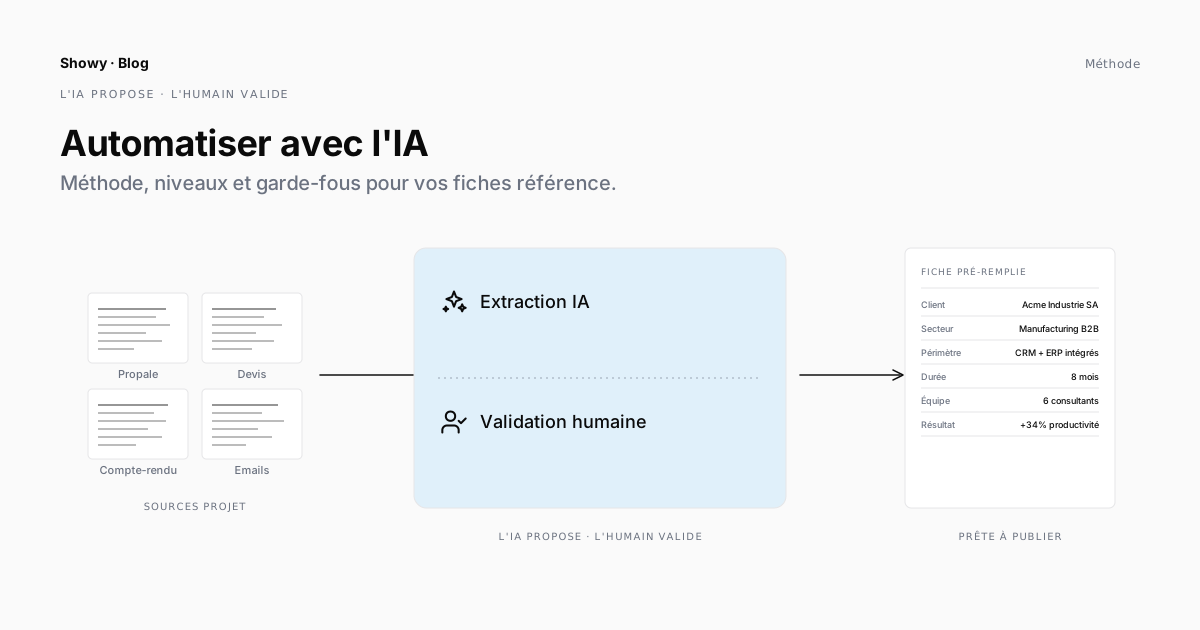
AI solves this mechanically: the material already exists in the project documents (won proposal, quote, closing report, emails, final deliverables). It’s just not in the right format. AI does the restructuring work. The project owner reviews it in five to ten minutes instead of writing for two hours.
Put differently: AI doesn’t create knowledge, it restructures it. That distinction is what separates useful automation from automation that drifts into invented content.
AI doesn’t do:
- The decision on whether a reference is relevant to a given proposal
- The choice of which quote to feature
- The hierarchy of KPIs (which one is dominant)
- The trade-off between what goes external and what stays internal
- The client relationship (consent request, quote validation)
These decisions stay human. AI speeds up the production of raw material. Editorial direction stays in the hands of marketing and sales.
Where AI draws the material from
Every professional services firm already produces the material for a reference record — they just don’t know it, because the material is scattered across several documents that were never meant to serve this specific need.
The won proposal contains the client context, the value promise, the proposed methodology. It’s the richest source for the descriptive fields (context, response delivered).
The quote or order carries the structured data: amount, scope, duration, dates, assigned team. It’s the source for the generic and quantified fields.
The closing report or end-of-project review contains the KPIs achieved, the difficulties resolved, the lessons learned. It’s the source for the quantified results and the implicit quote.
The project lead’s emails to the client document the project’s shifts, the trade-offs, the positive signals. Sources of precision and nuance.
The final deliverables (debrief decks, internal white papers, presentations to the client’s executive committee) are often the best sources of explicit quotes and validated figures.
These sources already exist in all your systems — CRM, project drive, ERP, office suite. AI’s job is to read them, extract what matches each field of the data model, and propose a pre-filled record. The record is never published automatically.
The non-negotiable principle: AI drafts, you approve
This is the principle that separates viable automation from automation that drifts. If you invert it — AI decides, the human corrects after the fact — you lose your grip on the quality of your library.
AI can pre-fill a record in seconds from project documents. It does so with high accuracy for structured fields (dates, amounts, cited technologies) and with more uncertain accuracy for descriptive fields (how the context is phrased, the choice of quote, the hierarchy of KPIs to feature). It’s precisely that uncertainty that justifies a human approving.
Approval doesn’t require writing — it requires checking, correcting, completing. It’s five to ten minutes of work for a record, where the initial writing took two hours. The ratio is such that adoption becomes possible: a project lead can spend ten minutes per project approving the record AI produced, where they refused two hours to write it themselves.
Three practices make this approval efficient:
AI distinguishes what it’s sure of from what it isn’t. A well-built record shows a confidence score per field. The owner knows where to focus their review — on the three or four fields flagged as uncertain, not on the eight others that are reliable.
Marketing approves sensitive records before external publication. Anything touching the client quote, public distribution, or the phrasing of the context goes through a marketing review before switching to “externally publishable.” AI speeds up the production of material. It doesn’t replace editorial decision-making.
The record owner stays identified and accountable. AI proposes, the owner approves, and they’re the one cited as contributor. This traceability prevents the drift of “no one reviewed it, the AI did it all on its own.”
Three levels of automation
Not every firm has the same need for automation. Three levels can be distinguished, by degree of investment and maturity.
Level 1 — Simple extraction. AI reads a document (the won proposal, the closing report) and extracts the structured elements: client name, industry, technologies, duration, amounts. The pre-filled record contains these fields; the owner fills in the descriptive fields by hand. Time saved: 30 to 50% per record. Setup effort: low. It’s the right starting level for most firms.
Level 2 — Complete pre-filled record. AI reads several documents (proposal, quote, report, deliverables) and produces a complete record, with structured and descriptive fields, and proposes a quote drawn from the documents when one is identifiable. The owner reviews and corrects. Time saved: 60 to 80%. Effort: medium — you have to connect the document sources.
Level 3 — Continuous updating. AI monitors new entries in your systems (a signature in the CRM, a closing in the ERP, the delivery of a final presentation) and automatically triggers the creation or evolution of a record at the appropriate status. The owner gets an approval notification at each step. Gain: the library builds in the background, with no manual chasing. Effort: high — you have to connect, configure, govern.
Starting at level 1 is often enough to transform the dynamic. Level 3 is a medium-term goal — it becomes relevant once the library has proven itself and internal maturity justifies it.
The two non-negotiable technical conditions
AI applied to client data raises two questions that must be settled before any deployment. If even one of the two isn’t guaranteed, the project isn’t legally viable.
No third-party model training on your data. This is the pivot. The contents of your won proposals, your reports, your closing emails, your client quotes are confidential by default. No serious reference-management tool feeds a public model with this data. Professional practice is to use models whose vendor contractually guarantees no training (zero-retention, no-training clauses), or to host inference in an isolated environment.
European hosting and GDPR compliance. The processed data contains personal information (names of client contacts, sometimes phone numbers, signatures, sometimes technical identifiers). Processing must comply with the GDPR: European hosting, an up-to-date processing register, guaranteed individual rights. This requirement immediately rules out solutions whose inference chain runs exclusively through US data centers or models whose chain isn’t auditable.
These two conditions aren’t marketing nuances. A professional services firm that automates without guaranteeing them exposes itself to legal and reputational risks out of all proportion to the productivity gain it’s after. Before any deployment, ask the vendor for:
- A written document on the data retention and training policy
- The location of the data centers used for inference
- A GDPR audit available or in progress
- A contractual reference to these commitments in your service agreement
Without these four, refuse the deployment.
Why AI doesn’t replace the library owner
There’s still a trap to avoid: believing that automation removes the need for an identified owner. It’s the opposite.
Without AI, the need for an owner is imposed by the entry burden — you need someone to chase, maintain, correct. With AI, that work largely disappears. But other responsibilities emerge:
- Validating the extraction settings (which source documents, which target fields)
- Arbitrating the cases where AI hesitates (fields flagged uncertain, contradictory proposals)
- Adjusting the model when systematically empty fields reveal a missing source
- Governing the confidentiality of the pre-filled data
- Periodically auditing the quality of AI-generated records
These new responsibilities are fewer than the old ones, and more strategic. But they still assume an identified owner. An automated reference library with no governance drifts faster than a manual one — because AI produces content faster than anyone can approve it, and the absence of approval accumulates silent errors.
The rule doesn’t change: no identified owner, no library — automated or not.
→ For the full method on structuring a reference library (modeling, templates, lifecycle, automation, distribution), download the Showy white paper — six steps you can apply separately, designed to reinforce each other.
FAQ
Can AI write a complete record with no human involvement?
Technically yes, in seconds. But publishing without approval means exposing your library to factual errors, misattributed quotes, or misread nuances. The “AI drafts, you approve” principle isn’t a slogan — it’s a quality guarantee you can’t negotiate.
How long does it take to deploy a level 1 automation?
Between a few days and a few weeks depending on your stack. Connecting the document sources (Drive, SharePoint, CRM, ERP) is the main variable. Once the sources are connected, AI extraction works from the very first record tested.
What if AI invents information that isn’t in the sources?
That’s a red flag. Check that the vendor configured the model in “strict extraction” mode and not “free generative” mode. A good tool refuses to pre-fill a field for which it found no information in the sources, rather than inventing one.
Can AI generate the client quote from emails or reports?
It can identify and propose explicit quotes that appear verbatim in your sources. It must never invent a quote the client didn’t actually say. This distinction is legally fundamental: attributing an unspoken sentence to a client is a serious reputational and contractual risk.
Do you need to own the AI model to guarantee confidentiality?
No, not necessarily. A contractual no-training guarantee with a serious commercial model is legally equivalent to hosting a proprietary model. What matters is the clarity of the vendor’s written commitment and the ability to audit. Proprietary hosting ≠ guaranteed confidentiality.