The most widely shared reflex in professional services firms: thinking of a reference as a binary object. It exists or it doesn’t. And it starts to exist the moment the project is delivered, when its record finally gets written.
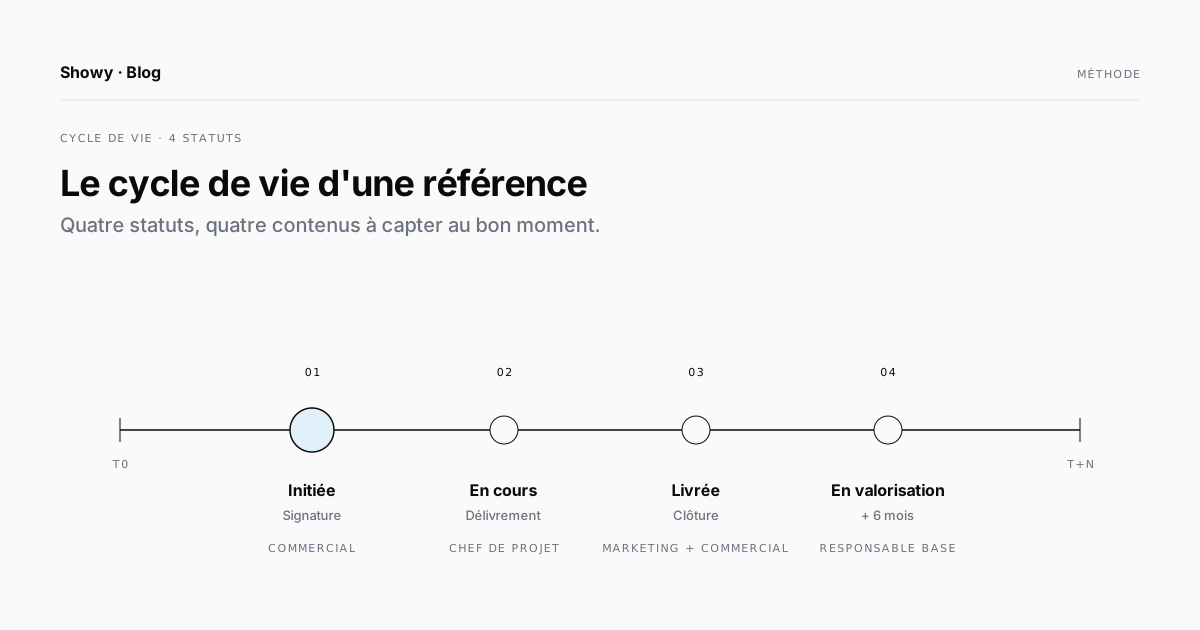
That reasoning costs three quarters of the value. A reference lives from the moment the contract is signed, changes nature at each stage, and keeps producing value years after the project ends. This article describes the four statuses of a living reference, the content each status can produce, and why capturing the material as you go saves hours per record.
A reference isn’t a fixed object
The dominant image of a reference in most professional services firms is a PowerPoint produced at the end of a project. The material is frozen at delivery: client name, duration, team, methodology, results. Anything that happens afterward is treated as an incidental bonus.
That image is misleading for two reasons.
First, the most useful material doesn’t appear at delivery. A project’s tactical context, the technical trade-offs, the first signals of adoption, the difficulties resolved — all the material that makes a reference truly convincing exists during the project, not after. If you wait for closing to capture it, you’re asking the project lead to reconstruct six months of work in their head, on top of their next project. The result is known: they won’t do it, or they’ll do it badly.
Second, a reference’s value increases over time if you maintain it. A project delivered two years ago, whose client renewed the engagement, whose results held up over time, whose scope was extended, is worth far more than a project delivered yesterday with a single figure. If you treat the reference as a fixed object, you lose that cumulative value.
The alternative is simple to state: think of the reference as a lifecycle. Four successive statuses, each with its natural content, its identified contributors, and its own time-to-value ratio.
Status 1 — Initiated: at signature
The project is sold but not started. The contract is signed, the scope is set, the team is known. At that precise moment, you already know five things about the project:
- The client and their industry
- The challenge they’ve entrusted to you
- The proposed methodological approach
- The duration and team size
- The engagement type (fixed-price, time-and-materials, advisory)
Five fields out of the twelve on a standard record. That’s not nothing.
Content to produce at status 1:
- A LinkedIn partnership announcement (if communication was authorized at signature)
- A mention in the internal newsletter to rally the teams
- A first minimal record in the library, “internally publishable” status
Main contributor: the rep who closed the deal. Entry takes ten minutes max. Marketing can take over to produce the external communication, but the raw material comes from the close.
Why it matters: the record exists from signature. It immediately serves the sales argument (“we’ve just opened a partnership with a European retail player on this topic”). And above all, it exists — so it will be easier to complete at the later statuses.
Status 2 — In progress: during delivery
The project is in active delivery. Several months, sometimes several quarters. At this point, concrete elements appear that you didn’t have at signature:
- The chosen technical architecture and its trade-offs
- The first deliverables produced and the first client reactions
- The adoption rate of the first rollout, the first weak signals
- The difficulties encountered and the solutions put in place
This material can’t always be written as a full narrative. It’s better captured as short notes, added as you go to the record: “tech X chosen because Y,” “first agency pilot at 67% adoption,” “sprint 4 marked by the legacy data migration.”
Content to produce at status 2:
- Structured notes in the record, fed by the project lead
- Occasional internal communication on the expertise that emerges
- If the client agrees, LinkedIn learning posts (“three pitfalls we avoided on this project” without naming the client)
Main contributor: the project lead or senior consultant. Not a writing chore, just five minutes a week to add short notes to the record.
Why it matters: this is when the most authentic narrative material is captured. Six months later, the project lead will have forgotten 80% of that context. Capturing as you go during the project is three to four times more efficient than reconstructing afterward.
Status 3 — Delivered: at closing
The project is finished. The final results are in, the client evaluation is done, sometimes a quote has been collected. This is the status everyone thinks of — and also the one where the record finally gets written in its complete form, with all twelve fields.
Content to produce at status 3:
- A complete record with all mandatory fields filled in
- A client quote requested and collected
- An illustrative visual produced if possible
- Automatic switch to “shareable in a proposal” status if the eight mandatory fields are filled
- Possible switch to “externally publishable” after obtaining formal client consent
Main contributors: the rep or project lead for the descriptive fields, marketing for approval and producing derived content (case study, web page, LinkedIn post).
Why it matters: this is the moment the record becomes officially usable in a proposal and in external communication. Without this passage through status 3, the reference stays in a permanent draft that no one really dares to use.
Essential note: if statuses 1 and 2 were properly fed, writing status 3 takes thirty minutes. If nothing was done before, it takes three to four hours and often ends up incomplete.
Status 4 — Ongoing value: six months and beyond
The project has been delivered for six months, a year, two years. The client kept using what was produced, additional results appeared, renewals happened, scope extensions were decided. The reference isn’t frozen at delivery — it can keep growing as long as the client relationship is alive.
Content to produce at status 4:
- Adding a KPI that held up over time (“six months after rollout, the initial gain held”)
- A mention of the contract renewal
- A mention of the scope extension (“the pilot was rolled out across all the group’s entities”)
- A new wave of content if good external news comes up (an award the client received thanks to the work, etc.)
Main contributor: the rep managing the account or the library owner. The cadence is light — a few minutes a quarter per active reference, triggered by specific events.
Why it matters: this is the status that gives older references their real depth. A reference you never add anything to after delivery quietly goes stale. A reference enriched every six months stays alive and more convincing every year that passes.
Why capturing from status 1 saves three times the time
The observation is mechanical. Capturing as you go, status by status, takes a cumulative 45 to 60 minutes per reference over the six-to-twelve months of the project. Retroactive capture at status 3, six months after delivery, takes 180 to 240 minutes — without the same quality guarantees.
Three reasons for that ratio.
The context is still top of mind. At status 1, the rep knows the client, the need, the key figures. At status 2, the project lead has the technical context in hand. At status 3 without prior capture, everything has to be reconstructed — that means digging through reports, emails, end-of-project slides, and rephrasing what was said out loud in meetings with no written trace.
Qualitative signals can’t be reconstructed. The quote the client said at closing, the remark that pivoted the project at week four, the technical trade-off that saved two months of delay — all this information exists at the moment it happens. Capturing as you go keeps it. Capturing afterward loses it.
The cognitive load is spread out. Five minutes a week for six months tires no one. Three hours of focused writing six months after delivery, imposed on a project lead already on their next project, is psychologically very different. The first regime holds. The second gets postponed indefinitely.
→ For the full method on structuring a living reference library, download the Showy white paper — six steps you can apply separately, designed to reinforce each other.
When to retire a reference from the library
Not every reference is meant to stay active forever. Three situations justify archiving — not deletion.
The client has explicitly revoked their distribution consent. A request that must be honored immediately: pulling public content, making the record private, keeping it only for internal history.
The reference has become technologically obsolete. A legacy-system migration done in 2014 has no sales value in 2026 — the technical and regulatory conditions have changed. Keep it internally, remove it from proposal and public distribution.
The reference is about an activity you no longer sell. You pivoted, you dropped a service line. The matching projects no longer serve the current sales argument. Archive and possibly migrate to a “historical” status.
Archiving isn’t deletion. It’s a status change. The data stays, accessible for audit, internal history, analysis of what you’ve sold over five years. It just no longer surfaces in everyday sales searches.
FAQ
Why four statuses and not three or five?
Four is the observed number that covers all needs without overloading. Three statuses (initiated, delivered, archived) leave a gap between signature and closing that’s precisely the period when narrative material is best captured. Five statuses add a granularity with no measurable benefit.
Does marketing have to approve every status change?
No. Statuses 1, 2, and 4 are managed autonomously by the natural contributors (rep, project lead, library owner). Only the switch to “externally publishable” — a sub-status of 3 — requires explicit marketing approval, with formal client consent.
What if public-distribution consent is never obtained?
The record stays “shareable in a confidential proposal” without switching to external. This is common and perfectly acceptable — most references in a library never become public. The internal use value is more than enough to justify maintenance.
How do you handle a reference whose client goes into a dispute?
Switch immediately to “internal only” until resolution. No external distribution, no proposal mention. If the dispute resolves favorably, return to the prior status. If the relationship degrades for good, archive.
How long does a reference stay relevant?
It varies by industry. In stable sectors (industry, retail), a reference stays relevant five to seven years. In technologically changing sectors (cloud, AI, data), three to four years max. Beyond that, the technical context has shifted so much that the reference becomes a point of history rather than an active sales argument.