In a professional services firm, references are the most under-invested sales asset. Everyone knows it, it gets said in the executive committee, and a quarter later nothing has moved. The reason is simple: the cost of a poorly managed reference doesn’t show up on a line of the income statement. It’s diffuse, shared across several teams, and everyone assumes the problem is somewhere else.
This article makes that cost legible. It describes four concrete forms it takes, offers an eight-signal diagnostic grid, and lists the three levers that actually move things — in that order, not the other way around.
What is a poorly managed reference?
A poorly managed reference isn’t a missing reference. It’s a reference that exists somewhere but doesn’t get used. Four situations come up on a loop in software and computing services companies, consulting firms, and agencies.
The unfindable reference. It’s mentioned in collective memory (“we did that for a retail client in 2022”) but no one knows which file documents it, or in what format.
The incomplete reference. A slide with a logo, a title, two sentences. No figures, no method, no name to ask. Unusable in a proposal the moment you go beyond a simple logo list.
The outdated reference. It dates from the initial delivery. The project has evolved since, results have come in, the client renewed their contract. None of that is in the record.
The scattered reference. The real details are in the project lead’s report, the figures are in the quote, the client quote is in an email, the visual is in the slide pool from the last sales offsite. To build a complete record, you have to reconstruct it.
These four cases share one thing: the reference exists, but it has a cost.
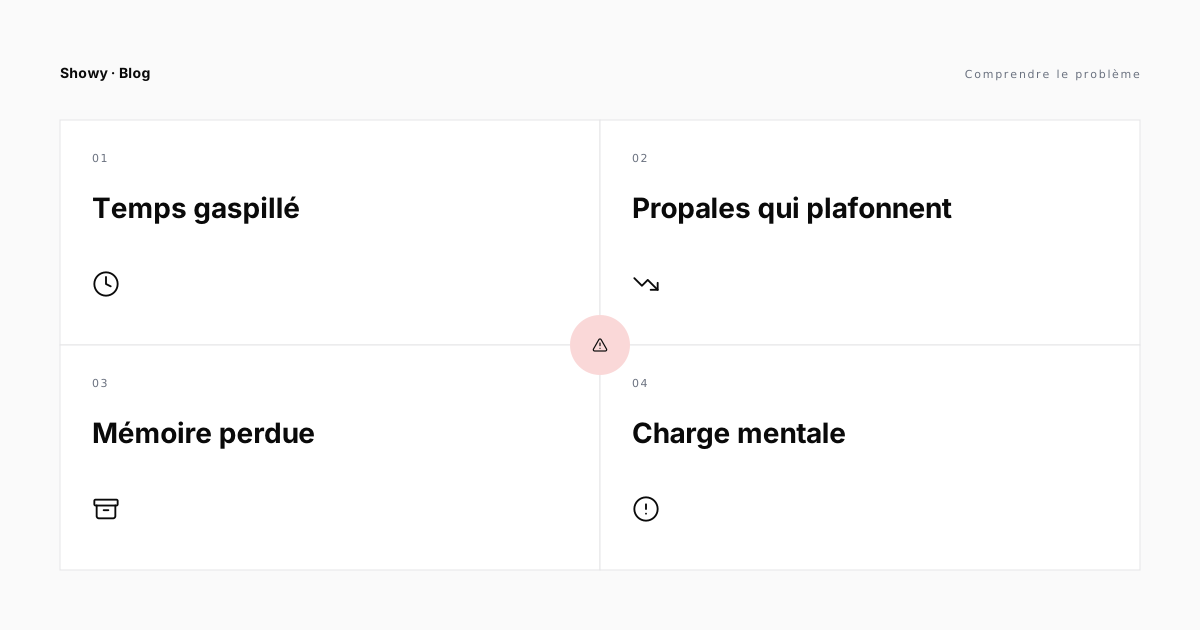
The four hidden costs of a poorly managed reference
The time no one bills
This is the most immediate and most invisible cost. Before every proposal, someone searches. According to a Cirrus Insight study (2026), a B2B sales rep spends an average of 10 hours a week searching for, comparing, or reworking content to send to a prospect. The same study notes that a rep spends only 28 to 32% of their time actually selling — the rest goes to admin, meetings, and searching.
In a professional services firm, that “content” to track down is mostly your references. A rep who has to find the three right retail references across Drives and old proposals spends two to three hours on a single RFP response. Multiplied by the number of proposals a month, that’s several days of sales time a month — unbilled, unreimbursed, and unseen.
Proposals that plateau
A relevant reference isn’t reassurance — it’s a sales argument. A 2017 Harvard Business Review study already ranked customer references ahead of company websites, marketing content, and sales presentations for their influence on B2B purchasing decisions. CSO Insights, in parallel, observes that only 46% of reps feel they have access to the right content to send a prospect — and that 65 to 70% of the content marketing produces is never used by sales.
What that means in practice: when your rep pulls a “roughly” relevant reference instead of the most relevant one, your proposal loses force. The gap doesn’t show on a single deal — you win or lose for a thousand reasons. It shows over time, in overall conversion, in sales-cycle length, in the margin given up in negotiation.
Memory that evaporates
A senior consultant leaves. Ten years of projects they carried in their head leave with them. If nothing is documented, your firm forgets in six months what it knew how to do for a decade. For a newcomer it’s even worse: they don’t know what the firm has already delivered, so they propose what they personally know how to do — not what the firm collectively knows how to do.
This memory loss has two measurable consequences. One, you more often start from scratch on subjects you’ve already handled — so slower, worse, less profitably. Two, onboarding new reps and consultants takes months where it could take weeks, for lack of simple access to past projects.
The silent mental load
The fourth cost is the hardest to quantify but the one teams talk about most. On the marketing side, it’s the constant effort to chase the delivery teams — forgotten reports, unfilled forms, approvals that drag. On the sales side, it’s the frustration of not finding, of having to improvise, of spending three days a month responding to a large-group vendor listing.
This load falls on no one in particular, so no one budgets for it. But it erodes productivity, motivation, and the quality of outgoing deliverables. And it eventually becomes an attrition argument on the marketing side: an unmaintainable reference library is one of the frustrations that drive away the most engaged comms and marketing leads.
How to know if this applies to you
Eight signals. If you check three or more, your firm is leaving value on the table.
-
The sales team doesn’t know where the recent references are. Asked, they name several possible places.
-
No one knows exactly how many references the firm has documented. The number varies by who answers.
-
When a new rep joins, they’re handed “the file”. An Excel, a Drive, or worse, “you have to ask Marie.”
-
You regularly fill in Excel vendor-listing matrices for large accounts, spending several days reconstructing them by hand.
-
Marketing chases the delivery teams by email to get records, and those emails go unanswered.
-
A rep preparing a proposal edits an existing reference slide without carrying the changes back to the source file. The record drifts with every use.
-
Your references are never updated after the project ends. They stay at the “launch” stage when the project delivered two years ago.
-
When a senior consultant leaves, the history of the projects they carried leaves with them.
Three signals out of eight is the empirical threshold beyond which the subject deserves a structural investment. Below it, one-off actions may be enough.
Three levers, in this order
Once the diagnosis is made, the temptation is to go shopping for a tool. That’s often a sequencing mistake. Three levers exist, and the order in which you pull them determines success.
1. Appoint an owner
The “references” subject with no identified owner goes nowhere, whatever the tool. Not a full-time project lead — a part-time point person with a clear mandate: approve the quality of what enters the library, arbitrate what goes out, and report usage to the executive committee.
The typical profile is on the marketing or sales-operations side. In a firm under 100 people, it’s usually the marketing lead. Beyond that, it’s often a marketing + sales-ops pair.
2. Model what a reference is at your firm
Before tooling up, define the data. What exactly is a reference at your firm? Which fields are mandatory for a record to be publishable? Which fields are internal? What output formats does your firm expect — proposal slide, large-account RFP slide, web page, industry sheet?
This step isn’t an IT project; it’s a half-day workshop with a few people from marketing and sales. You come out with a template record. That’s what then guides the choice of tool.
3. Tool up, with eyes open
With an owner and a model, choosing a tool becomes an evaluation exercise, not a leap into the unknown. The market offers five broad approaches: a document library, Notion, an extended CRM or ERP, custom development, a dedicated SaaS. Each has its place depending on your volume, your maturity, and your sales cycle.
→ To go deeper on choosing a tool, see: Customer reference management software: which approaches for professional services firms?
FAQ
What’s the difference between a customer reference and a case study?
A customer reference is the structured entity that describes a delivered project: client, context, engagement, key figures, technologies. A case study is a narrative distribution format built from a reference — usually a 2-to-5-page document for an external audience. A good reference lets you produce several case studies, from several angles.
How many references should a professional services firm have?
There’s no universal threshold. What matters is that every industry, every client size, and every type of engagement you sell is represented by at least two usable references. A firm selling three main engagements to four target industries should aim for at least twenty-four complete, up-to-date, ready-to-use references.
Who should own the reference library?
Generally, marketing for production and approval, sales for use and upkeep. In smaller firms, one person wears both hats. The criterion that works: the person in charge must have an explicit mandate and dedicated time, even part-time.
How do you measure the impact of better reference management?
Three simple metrics: reference usage rate in proposals (how many proposals go out with at least one relevant reference), average time to build a proposal, and conversion rate on deals where a reference is cited vs deals without. The first two are measurable as soon as a tool is in place. The third needs six to twelve months of hindsight.
Do you need the client’s consent to use a reference?
For external distribution (public case study, web page, LinkedIn post), yes — always, ideally in writing. For internal use or a confidential proposal, it depends on the original contract: some contracts explicitly allow being cited as a reference, others forbid it. Check on each project.